
If you are a registered architect in New South Wales, your annual registration renewal depends on more than just paying a fee.
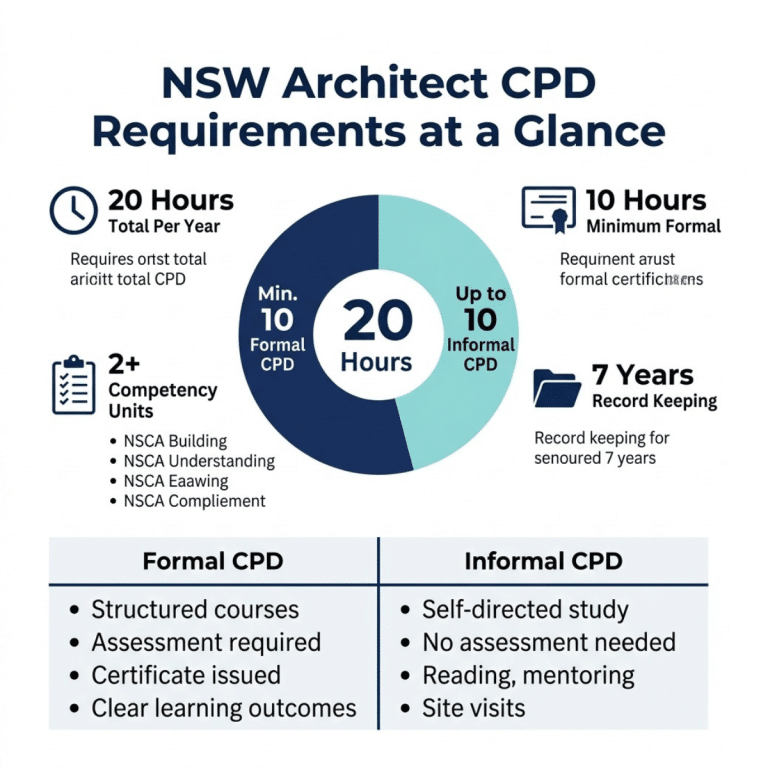
The NSW Architects Registration Board (NSW ARB) requires every practising architect to complete and report on a minimum of 20 hours of Continuing Professional Development each year, with at least half of those hours classified as formal CPD.
Failure to meet this requirement can result in removal from the NSW Register of Architects, which is a consequence that many practitioners underestimate until it is too late.
This guide explains exactly what the NSW ARB expects, how formal and informal CPD differ in practice, which competency areas your activities must address, and how to maintain records that will withstand a compliance audit.
Table of Contents
ToggleThe 20-Hour Annual Requirement
Under the NSW Architects Code of Professional Conduct, registered architects must undertake at least 20 hours of CPD per year.
Of these, a minimum of 10 hours must be formal CPD, while the remaining 10 hours may consist of informal (self-directed) professional development.
This requirement applies regardless of whether you are working full-time, part-time, or in a non-traditional role.
There is no pro-rata reduction for part-time practitioners. If your name appears on the NSW Register of Architects, you are expected to meet the full 20-hour standard.
It is worth noting that while the 20-hour figure is often described as a minimum, it is also, in practice, the target most architects aim for.
There is no additional benefit or recognition from the board for exceeding it, though the professional development itself may well prove valuable. For a broader overview of how CPD requirements compare across all Australian states, our national CPD points guide provides a useful reference.
Formal CPD vs Informal CPD: What Actually Counts

The “why now” is straightforward. Specifiers and commercial builders are being asked, today, to demonstrate Indigenous participation in their projects. If the products on their schedule can’t carry that demonstration, the obligation falls on project stakeholders to construct it through other means, usually a tacked-on artwork commission or a one-off signage piece. That approach is fragile, expensive per outcome, and increasingly unconvincing to the panels reviewing it.
A range that builds Indigenous authorship and community benefit into the line item itself is a more durable answer.
What Qualifies as Formal CPD?
Formal CPD is defined as a structured educational activity that goes beyond your normal course of practice or employment. To qualify as formal, an activity must meet all of the following criteria:
- It must have presenters or facilitators with appropriate academic, technical, or practical expertise;
- It must include clearly stated learning outcomes that are mapped to the 2021 National Standard of Competency for Architects (NSCA);
- It must incorporate a structured assessment task, such as a quiz, written reflection, or practical test, to verify understanding; and it must result in a certificate of completion that can be retained as evidence.
In practical terms, formal CPD typically includes accredited short courses and workshops, structured online learning modules with assessments (such as those offered through Archify Education or CPD Live), AIA Refuel-accredited presentations, university-delivered professional development programs, and supplier-led technical presentations that include an assessment component.
What Qualifies as Informal CPD?
Informal CPD encompasses self-directed study and professional activities that relate to your practice but do not include the structured assessment or significant interaction required for formal classification.
Common examples include reading industry journals, technical publications, or relevant legislation; mentoring junior staff or being mentored by a senior practitioner; attending industry networking events or exhibitions; conducting site visits for learning purposes; and engaging in independent research on materials, building systems, or design methodologies.
A common misunderstanding is that attending a conference presentation automatically counts as formal CPD. In most cases, it does not, unless the session includes a structured assessment component. Sitting in the audience and listening, no matter how informative the content, typically qualifies only as informal CPD.
The Four NSCA Competency Units
All CPD activities must relate to one or more of the four competency units defined by the 2021 NSCA. Each year, your CPD portfolio must cover a minimum of two of these four units:
Unit | Competency Area | Example CPD Topics |
1 | Practice Management and Professional Conduct | Contract administration, professional ethics, risk management, business planning |
2 | Project Initiation and Conceptual Design | Client briefing, site analysis, feasibility studies, design strategy |
3 | Detailed Design and Construction Documentation | Material specification, NCC compliance, accessibility standards, technical detailing |
4 | Design Delivery and Construction Phase Services | Contract administration during construction, site observation, defect management |
For architects involved in specification and detailing work, Unit 3 is typically the most relevant and the easiest to address through targeted CPD. A technical presentation on commercial wet area design, for instance, covering material performance, mounting systems, and compliance with accessibility standards, maps directly to this competency area.
How to Report Your CPD?
The NSW ARB provides an online “My CPD” portal within its My Account system. Architects are strongly encouraged to log activities progressively throughout the year rather than attempting to compile everything at renewal time.
When logging an activity, you will typically need to record the date and duration of the activity, a description of the content covered, the provider or source, the NSCA competency unit(s) addressed, whether the activity was formal or informal, and the certificate of completion (for formal CPD).
Reporting generally occurs as part of the annual registration renewal process. The board does not manually review every submission, but it does conduct random compliance audits, and being unable to substantiate your logged activities can have serious consequences.
Record-Keeping: Preparing for a Compliance Audit
The NSW ARB requires architects to retain CPD records for a minimum of seven years. This is longer than the five-year retention period required in some other states, and it means that records from several renewal cycles ago may still be requested during an audit.
Effective record-keeping should include completion certificates for all formal CPD activities, a contemporaneous log noting dates, hours, topics, and providers, copies of session outlines, course materials, or presentation slides where available, and any assessment results or written reflections.
A practical approach is to maintain a dedicated digital folder (organised by financial year) where you store certificates and notes immediately after completing each activity. Waiting until the end of the year, or worse, until an audit notice arrives, almost inevitably leads to gaps in documentation.
For a more detailed breakdown of CPD record-keeping strategies and audit preparation, our article on CPD rules for architects covers the process comprehensively.
Consequences of Non-Compliance
The Architects Act 2003 (NSW) gives the board the authority to take disciplinary action against architects who fail to meet their CPD obligations. Possible consequences include a formal finding of unsatisfactory professional conduct, conditions imposed on your registration (such as mandatory supervised practice), and in the most serious cases, removal from the NSW Register of Architects.
Being removed from the register means you cannot legally use the title “architect” in NSW, which has immediate implications for your ability to practise, sign documentation, and hold professional indemnity insurance.
The board has also indicated that a pattern of minimal or last-minute compliance, while technically meeting the letter of the requirement, may attract scrutiny during an audit. Demonstrating a genuine, sustained commitment to professional development across multiple competency units is the safest approach.
Practical Tips for Meeting Your NSW CPD Requirements
Rather than viewing CPD as an annual administrative hurdle, architects who plan strategically tend to find the process smoother and more professionally rewarding.
Start early in the year. Aiming to complete the bulk of your CPD in the first two quarters removes the pressure of last-minute scrambling. It also gives you flexibility to spread activities across multiple competency units.
Mix your delivery formats. A combination of online modules, in-person workshops, and supplier-led presentations keeps the learning varied and covers different competency areas naturally. For example, completing two or three online courses through Archify or CPD Live in the first quarter, attending a DuraCube architect training session in the second quarter, and participating in a conference or seminar later in the year creates a well-rounded portfolio.
Align CPD with current projects. If you are working on a healthcare facility, seek out CPD related to accessible design and infection control specifications. If you are specifying wet area fitouts, a technical session on partition systems and locker design aligns your CPD with the competency you are actively applying.
Log activities immediately. The five minutes it takes to upload a certificate and note the competency unit immediately after a session is vastly preferable to trying to reconstruct the details months later.
Understanding Why CPD Matters Beyond the Checkbox
Meeting the 20-hour requirement keeps you on the register, but the broader value of CPD lies in its contribution to your professional competence and market positioning. Building codes and Australian Standards are updated regularly, and an architect who has not engaged with the latest NCC amendments or accessibility requirements is at genuine risk of producing non-compliant documentation.
Beyond compliance, CPD is also a competitive differentiator. Clients and project managers increasingly expect architects to demonstrate current knowledge, particularly in areas like sustainability (Green Star, NABERS), inclusive design, and material innovation. Architects who can speak confidently about the latest developments in their specification areas, whether that is compact laminate technology, waterproofing membranes, or privacy-focused partition design, position themselves as knowledgeable and trustworthy partners.
For a deeper exploration of why CPD is essential for architects beyond mere registration renewal, our article on staying compliant and competitive examines the strategic case.
Next Steps
If you are looking for practical, specification-relevant CPD that addresses NSCA Unit 3 (Detailed Design and Construction Documentation), explore DuraCube’s CPD training for architects. Sessions cover technical specifications for commercial toilet partitions, locker systems, and wet area design, and can be arranged at a time and format that suits your practice.
Contact us: Call 1300 387 228 or email sa***@**********om.au.