
Designing for inclusion in Australia often leads to confusion between “ambulant” and “accessible” terms. However, each term refers to a distinct facility type. Designers must tailor these spaces to specific physical requirements. Furthermore, overlooking these differences can lead to non-compliant designs. This mistake also creates legal risks under the Disability Discrimination Act 1992.This article breaks down the key differences between ambulant and accessible toilets, referencing AS 1428.1:2021 and NCC 2022 Volume One – Part F4, with emphasis on updated spatial, fixture, and signage requirements.
Table of Contents
ToggleUnderstanding the Distinction
Book A FORMAL CPD PRESENTATION
Australian
Cubicle Standards
Gain insights into the standards and regulations governing public cubicle design.
What is an Ambulant Facility/ Ambulant Toilet?
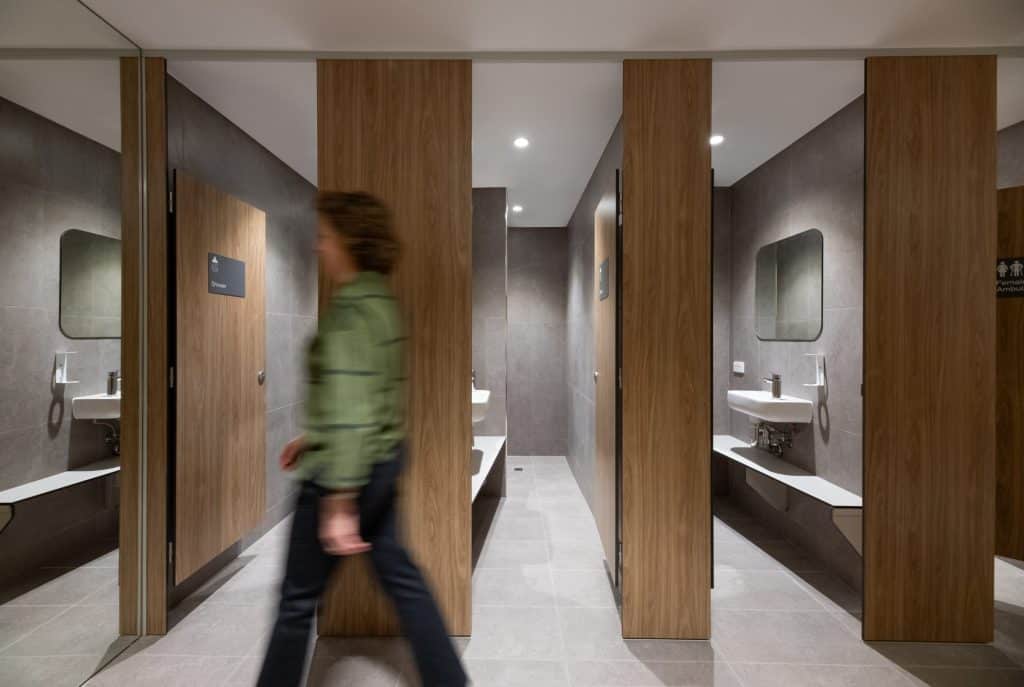
An ambulant cubicle serves individuals with mobility limitations who do not use a wheelchair. For example, people with arthritis or those using walking aids benefit from these spaces. Typically, builders locate these stalls within standard male and female blocks. They feature enhanced support like grab rails and increased widths to ensure safer movement.
Note: NCC 2022 and AS 1428.1 mandate clear dimensions and fixtures, and non-compliance can lead to building code breaches.
What is a Wheelchair Accessible Bathroom / Accessible Bathroom?
In contrast, a wheelchair accessible bathroom (formerly “accessible toilet”) is a dedicated, larger space. It caters to wheelchair users or those requiring a carer’s help. These rooms must provide enough space for a full 360-degree turning circle. Additionally, they include specific fixture heights and luminance contrast seating to help users remain independent.Most accessible toilets are unisex, as per F4D5 of NCC 2022, ensuring privacy and flexibility.
Ambulant Toilet Requirements – AS 1428.1:2021
Feature | Requirement |
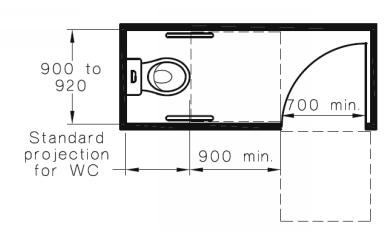
Cubicle Width | 900mm to 920mm |
Door Clearance | 900mm clearance between pan and door swing (inward or outward) |
Grab Rails | Required on both sides of toilet pan (Clause 17, Fig. 53A) |
Toilet Pan | Projection: 610–660mm; seat height: 460–480mm |
Signage | Braille and tactile; installed 1200–1600mm AFFL with LH/RH cubicle indicator |
Door Opening Width | Minimum 700mm (per Figure 53B) |
Snib Handle | Minimum 45mm from spindle centre (for emergency access) |
In-Use Indicator | Required (visual indicator on lock) |
Latch Mechanism | Must be openable from outside (in emergency situations) |
Coat Hook | Must be provided inside the cubicle at 1350–1500mm AFFL |
Lift-off Hinges | Required for outward opening doors to allow emergency access |
Wash Basin | Must not intrude into circulation space |
New Update: The 2021 update to AS 1428.1 now places greater emphasis on spatial layout, reinforcing that washbasins in ambulant cubicles must never intrude into circulation.
Accessible Toilet Requirements – AS 1428.1:2021 & NCC 2022 Volume One – F4D5 to F4D7
Accessible toilet facilities must meet the following minimum specifications:
Feature | Requirement |
Circulation Space | 2300mm x 1900mm (minimum clear floor space) |
Grab Rails | L-shaped (side) and horizontal (rear); 800–1100mm AFFL |
Toilet Seat | Must provide 30% luminance contrast with upright lid |
Wash Basin | Installed 800–830mm AFFL with knee and toe clearance |
Mirror | ≥350mm wide; bottom ≤900mm AFFL, top ≥1850mm AFFL |
Door Force | Must not exceed 20N to open |
Door Type | Outward-opening or sliding; must allow removal from outside in emergencies |
Signage | Braille, tactile text + International Symbol of Access (1200–1600mm AFFL) |
Coat Hook | Required; 1200–1350mm AFFL |
Additional Fixtures | Shelf, sanitary bin (on non-transfer side), optional power outlets |
New Update: NCC 2022 F4D5 & F4D6 mandates at least one accessible unisex toilet in common areas for applicable building classes (e.g., Class 5–9), located without crossing into single-sex zones.
Common Mistakes to Avoid
- Assuming one size fits all – Each facility serves a different purpose; mixing them up can lead to costly redesigns
Installing only one type of facility – Both ambulant and accessible toilets may be required to meet building code compliance, particularly in public or commercial buildings.
Overlooking door clearances – Non-compliant door swings are among the top causes of audit failure.
Omitting compliant signage – Signage must include tactile, braille, and international symbols of access, with specific mounting heights.
- Confusing ambulant cubicles with a full wheelchair accessible bathroom – Ambulant cubicles lack the 2300mm x 1900mm circulation space required for wheelchair users
Why Compliance Matters
Following NCC 2022 and AS 1428.1 standards provides more than just legal safety. Most importantly, it offers dignity to all users. By correctly installing wheelchair accessible bathrooms and ambulant stalls, you ensure every visitor navigates your building with ease
Summary Table: Key Differences
Feature | Ambulant Toilet | Accessible Toilet |
Space Required | ~900mm cubicle width | 2300mm x 1900mm circulation |
Intended Users | People with limited mobility (not wheelchair users) | Wheelchair users and those needing assistance |
Grab Rails | Both sides | Side and rear (with specific layout) |
Door Width | ≥700mm | ≥850mm (recommended) |
Signage | Tactile and braille | Tactile, braille + International Symbol of Access |
Wash Basin Location | Outside cubicle | Inside, with clearance |
Floor to Seat Height | 460–480mm | 460–480mm |
Conclusion
Incorporating both ambulant and accessible toilets into your facility design ensures compliance, promotes inclusion, and provides comfort to a wider user base. Whether you’re a designer, builder, project manager, or facility planner, understanding these requirements is critical to avoiding errors and fostering a more inclusive built environment.
Further Reading
Need a compliance check? Send us your plans for a professional review today. We will help your next project meet all Australian standards.