
Compact laminate turns up on almost every commercial washroom, change room and end of trip schedule in Australia, yet it is still frequently confused with the thin decorative laminate bonded to a particleboard substrate. The two products share a family name and almost nothing else. This guide sets out what compact laminate actually is, how it performs, what thickness to specify where, and how it compares with phenolic, HPL and MDF alternatives, with completed Australian projects showing each property at work.
Key Takeaways
- Compact laminate is a panel, not a finish: layers of kraft paper are saturated in thermosetting phenolic resin and fused under heat and pressure into a solid, self-supporting board. It needs no substrate and has no edge tape to lift.
- Thickness decides the application: 6mm suits wall linings and light locker components, 13mm is the Australian workhorse for toilet partitions and vanities, and 18mm and above handles heavy-duty benchtops.
- One supplier can cover the entire amenity: partitions, vanities, lockers and bench seating all come off the same DuraSafe material line, which removes colour-match risk and collapses the supply chain to one point of accountability.
- Stocked and cut to size beats sheet-only supply: DuraSafe holds 30 colours in Australia and CNC cuts, drills and profiles panels to your drawings, so programme risk sits with stock on hand rather than an indent order.
Table of Contents
ToggleWhat Is Compact Laminate?
Compact laminate, also written as compact high pressure laminate or CHPL, is a solid structural panel rather than a surface finish. It is built the way any laminate is built, by bonding thin layers together under pressure, but instead of stopping at a decorative skin the layers are stacked up into a full-thickness board. Multiple layers of kraft paper are impregnated with thermosetting phenolic resin, topped with decorative paper and an overlay saturated in melamine resin, then consolidated under high pressure and heat into a single homogeneous board. The result is a dense, non-porous panel that carries its own load and is finished on both faces.
That difference in construction is what separates the two products in practice. Conventional high-pressure laminate is a thin decorative sheet, typically under 1mm, that must be bonded to a substrate such as particleboard or MDF and then edge taped. In a washroom, those two components are precisely where failure starts: the substrate swells as soon as water reaches it through a drilled hole or a lifted edge, and the edge tape peels under cleaning and impact. Compact laminate has neither a substrate nor an edge tape, so there is no weak point to fail. That single structural advantage is why it dominates wet areas, high-traffic amenities and vandal-prone environments.
Manufacturing is what locks that performance in. The impregnated stack is pressed at roughly 7MPa and around 150 degrees Celsius, and under that pressure the resins cure irreversibly, cross-linking the paper layers into one solid mass with a typical density around 1.35g/cm3. There is no glue line holding a face onto a core, because there is no separate core to hold.
That cured mass is what gives compact laminate its familiar dark edge. On DuraSafe panels the edge is polished so it reads as a deliberate detail rather than a raw cut, which matters when every partition, vanity and locker edge is on show.
Compact Laminate Thickness: What to Specify Where
Compact laminate is manufactured in a range of thicknesses, and the specification decision is almost always structural rather than aesthetic. The panel is doing the work of the substrate, so thickness has to match span, load and hardware.
Thickness | Typical applications | Why this thickness |
|---|---|---|
4mm to 6mm | Wall linings, splashbacks, ceiling panels, locker door faces, signage, duct access panels | Non-structural cladding over a supporting surface. Light, easy to fix, and cost-effective across large areas. |
8mm to 10mm | Locker bodies and dividers, shelving, light-duty cubicle doors, joinery carcasses | Enough rigidity for short spans and light loads while keeping weight and cost down. |
12mm to 13mm | Toilet partition doors, pilasters and dividers, vanity tops, privacy panels, bench seating, table tops | The Australian commercial standard. Takes through-fixed hardware, resists door slam and spans normal cubicle widths without flexing. |
18mm and above | Heavy-duty benchtops, worktops, laboratory surfaces, structural pilasters, exposed edges requiring visual weight | Specified where deflection, edge presence or heavy point loading governs. |
For most commercial amenity work in Australia, the answer is 13mm. DuraCube partitions, vanities, lockers and bench seating are built from 13mm compact laminate with a 1.5mm aris to the top and bottom edges, which softens the arris without adding a separate edge component that could fail.
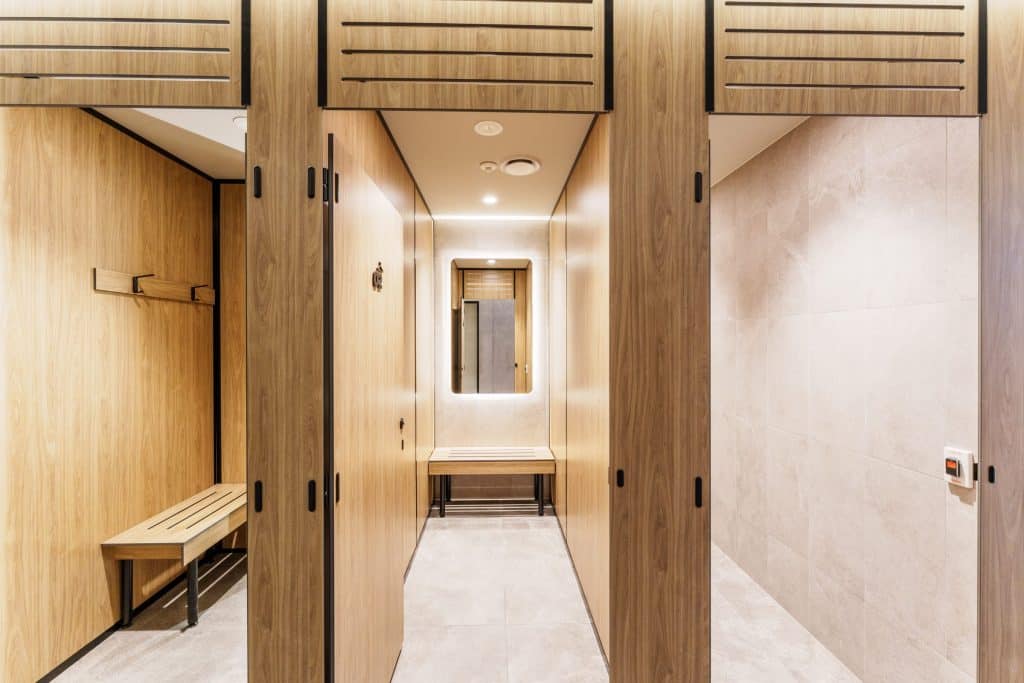
Project In Focus - Anytime Fitness, Ropes Crossing NSW
Architect: Archi Spectrum | Builder: Vantage Space | Systems: Full Height Privacy Core (FHPC), Bench Seating Wall with Coat Rail (BSW-C) | Colour: DuraSafe 5333 Southern Pine
A 24/7 gym has no closed period in which materials recover. Change and shower areas run continuously, humidity never fully clears, and the finish has to hold its appearance under that load while delivering acoustic separation and privacy.
The Full Height Privacy Core system was specified in 13mm DuraSafe compact laminate in 5333 Southern Pine, floor to ceiling, with slotted airflow panels managing ventilation inside the enclosed cubicles. Bench seating in the identical Southern Pine colourway ties the change area back to the cubicles rather than reading as a separate package.
The Properties That Matter in Commercial Amenities
A washroom or change room punishes materials in four specific ways, and compact laminate answers each of them. The projects below show every property tested in the field, all of them delivered in DuraSafe compact laminate.
Water and Moisture Resistance
Because the panel is solid and non-porous, water has nothing to soak into. There is no exposed particleboard core at a drilled hole, no seam for moisture to track along, and no glue line to fail. Panels can be hosed, steam cleaned and specified in showers, change rooms, lockers and public toilets without swelling or delaminating.
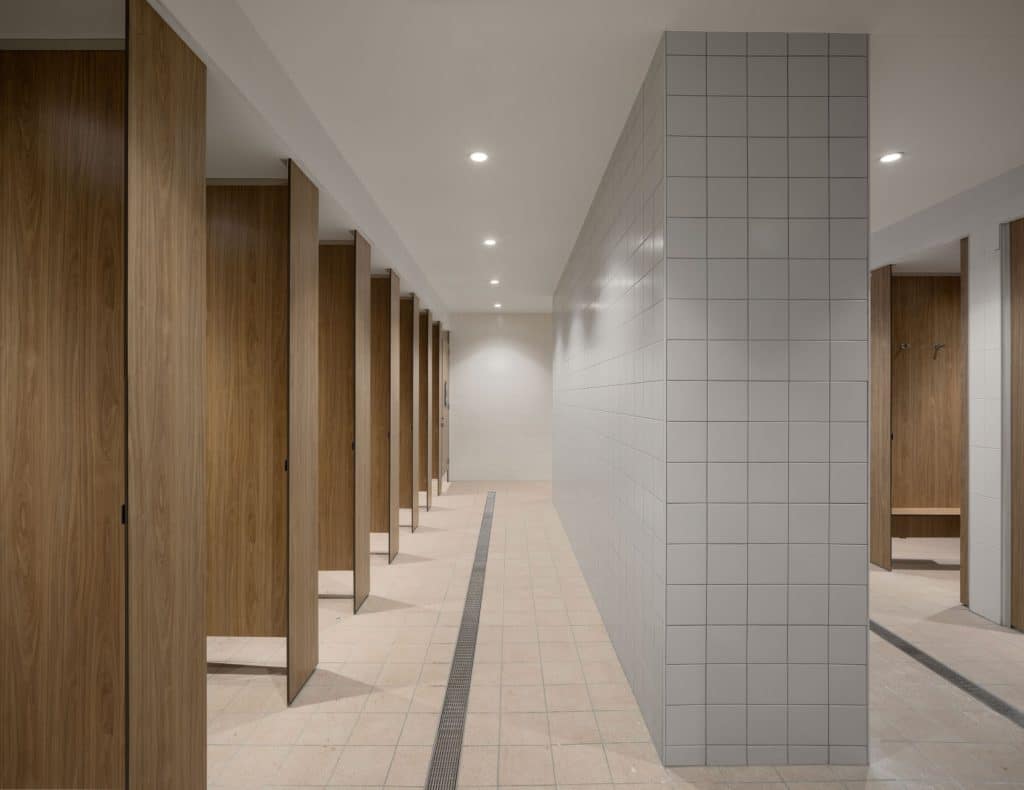
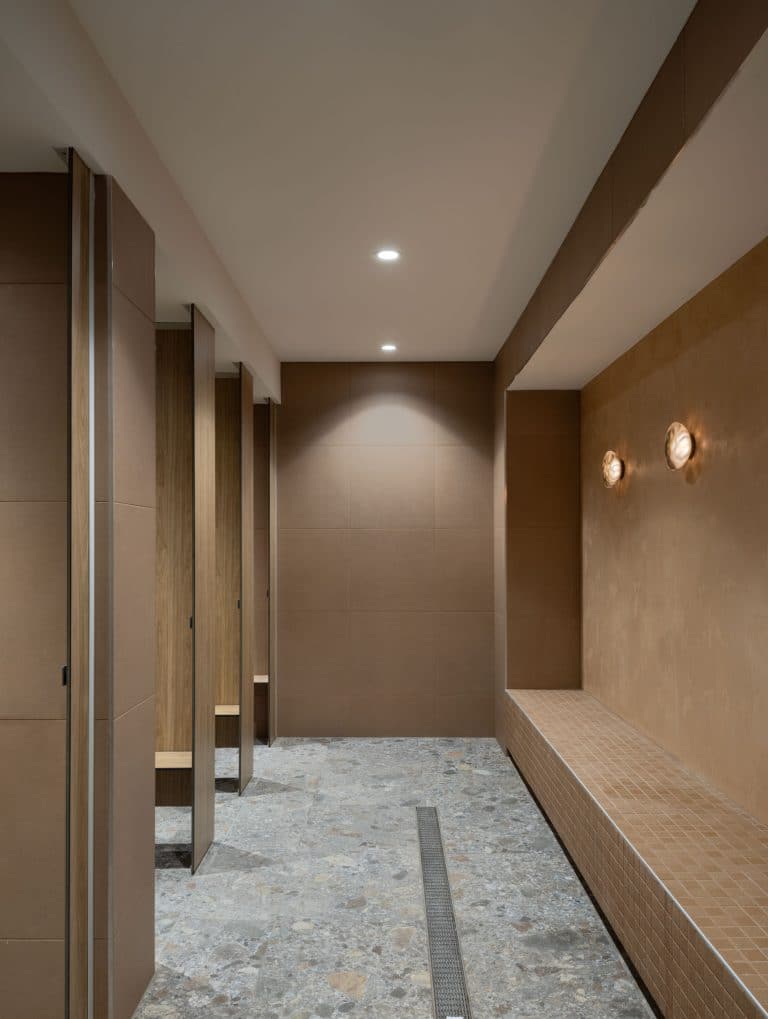
Project In Focus - Adelaide Aquatic Centre (Kauwingka), North Adelaide SA
Architect: Warren and Mahoney with JPE Design Studio | Builder: Sarah Constructions | System: Floor Mount Ceiling Fixed (FCF) | Colour: DuraSafe 5333 Southern Pine
A 50-metre indoor competition pool, a 25-metre outdoor pool, learn-to-swim and warm water rehabilitation pools, waterslides, sauna and steam. There are few harder tests of a material than the change rooms behind that program: permanent humidity, constant splash contact and daily commercial cleaning regimes.
DuraCube supplied and installed its FCF partitioning system throughout the change rooms and amenities in DuraSafe 13mm compact laminate, specified in 5333 Southern Pine for a warm timber read. Matching Southern Pine compact laminate shower seats carried the same material into direct-spray zones, where a substrate-based panel would be the first component to fail.
Impact and Scratch Resistance
The melamine overlay is one of the hardest decorative surfaces used in commercial joinery, and the resin-cured kraft layers behind it absorb impact rather than crushing. Those layers are the same phenolic-resin construction described above, simply built up to full thickness, so the panel resists impact the whole way through rather than only at the surface. Door slams and the everyday wear and tear of public spaces that would dent a substrate-based panel leave compact laminate intact. This is why it is specified in schools, stadiums, shopping centres and other heavily used public buildings.
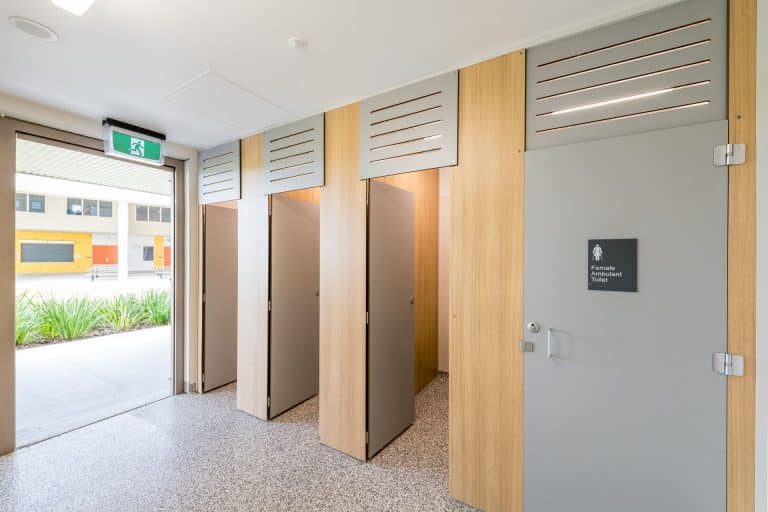
Project In Focus - Palmview State Primary and Special Schools, Sunshine Coast QLD
Architect: 8i Architects with Mode Design Corp | Builder: FKG Group | System: Full Height Privacy Ultra (FHPU) | Colours: DuraSafe 5003 Philippine Teak, 268 Evening, 284 Sky
Two schools delivered under the Queensland Government’s Building Future Schools Program, serving the Palmview Learning Community. Amenities in a school absorb hundreds of uses a day from users who are not gentle with them, and the material has to still look current a decade later.
Full Height Privacy Ultra systems were specified across multiple blocks in compact laminate, with ambulant cubicles on wider outward-swinging doors and compact laminate shower seats and splash nibs integrated into the wet zones. Three DuraSafe colours carry a neutral contemporary palette across both campuses without introducing a second material.
Impact and Scratch Resistance
The melamine overlay is one of the hardest decorative surfaces used in commercial joinery, and the resin-cured kraft layers behind it absorb impact rather than crushing. Those layers are the same phenolic-resin construction described above, simply built up to full thickness, so the panel resists impact the whole way through rather than only at the surface. Door slams and the everyday wear and tear of public spaces that would dent a substrate-based panel leave compact laminate intact. This is why it is specified in schools, stadiums, shopping centres and other heavily used public buildings.
Graffiti and Vandal Resistance
The closed surface gives permanent markers and paint nothing to key into, so most graffiti lifts with a solvent or citrus cleaner and no residual ghosting. Combined with the solid core, this makes compact laminate one of the few materials that survives an unsupervised public washroom over a fifteen-year horizon.
Hygiene and Cleanability
A non-porous surface with no joints, no edge tape and no substrate cavity gives bacteria nowhere to colonise. DuraSafe compact laminate carries an antibacterial surface that prevents the growth of 98% of bacteria, and the panel tolerates the hospital and food-grade cleaning regimes that would strip a lesser finish.
Compact Laminate vs Phenolic, HPL and MDF
Specifications use several different names for panels that look interchangeable on paper but behave very differently once installed. This section sets out what each alternative actually is, so a substitution request can be judged on the facts rather than on the name.
Phenolic panel is simply what compact laminate is called in North America. It is the same phenolic-resin construction described above, so when a project calls for a solid phenolic partition and a compact laminate partition, it is describing the same product twice. The two genuine alternatives are different things entirely. HPL on substrate is that thin decorative laminate sheet, under 1mm, glued to a particleboard or MDF board and edge taped, so the laminate is only the skin. Moisture-resistant MDF is a resin-treated fibreboard, painted or laminated, that handles humidity better than standard MDF but is not waterproof.
Compact laminate (CHPL) | Phenolic panel | HPL on substrate | Moisture-resistant MDF | |
|---|---|---|---|---|
Construction | Solid phenolic-resin core with melamine decorative faces, pressed as one panel | Same core technology; term used interchangeably with compact laminate | Decorative laminate under 1mm bonded to particleboard or MDF, edge taped | Resin-treated fibreboard with a painted, laminated or veneered finish |
Self-supporting | Yes | Yes | No, relies on the substrate | Yes, but with far lower strength |
Wet area suitability | Excellent, including showers and external alfresco use | Excellent | Limited; edges and fixings are the failure point | Poor to moderate; swells once the finish is breached |
Edge treatment | Machined solid edge, black core polished, no edge tape | Machined solid edge | Edge tape that can lift or peel | Edge tape or painted edge |
Impact and vandal resistance | High | High | Moderate; surface survives, core does not | Low |
Typical thickness | 4mm to 20mm | 6mm to 25mm | 16mm to 33mm assembly | 16mm to 33mm |
Best use | Toilet partitions, vanities, lockers, bench seating, wet areas | Same applications, US-specified projects | Dry-area joinery, cabinetry, office fitout | Dry-area cabinetry and low-traffic joinery |
Read across the table and the pattern is consistent. Compact laminate and phenolic panel match on every row, because they are the same panel under two names. HPL on substrate keeps pace on surface hardness but fails on the rows that decide a washroom: it is not self-supporting, its edge tape can lift, and once water reaches the substrate through a fixing or a damaged edge the board swells. Moisture-resistant MDF trails on every performance row and belongs in dry areas only. In short, if the surface will get wet, knocked or written on, compact laminate is the specification. If it lives in a dry office and cost is the driver, an HPL or MDF assembly is defensible. There is no wet-area case where MDF outperforms compact laminate over the life of the asset. Once the material itself is settled, the next specification decision is not what to buy but how many suppliers to buy it from.
One Material Line, One Supplier, Every Amenity
The most under-used advantage of compact laminate is not technical; it is procurement. Because a single material line can produce partitions, vanities, lockers, privacy panels and bench seating, one supplier can deliver an entire amenity from the same stock, whether you run one colour throughout for a unified look or vary the palette between zones.
Specified the usual way, a washroom and change room package draws on several suppliers: a partition manufacturer, a joinery shop for the vanity, a locker supplier, a bench seating supplier. Each holds different stock, quotes different lead times, and matches your nominated colour to a different tolerance. A neutral grey from four sources is four slightly different greys, and the mismatch only becomes visible at practical completion when there is no time left to fix it.
Project In Focus - St George Illawarra Dragons, Bruce Gordon Centre, North Wollongong NSW
Architect: Populous | Builder: FDC Construction | Systems: FOB partitioning, Bench Seating Wall with Coat Rail (BSW-C), Lockers Bench Mounted (LBM) | Colour: DuraSafe 279 Charcoal
The clearest demonstration of single-colourway specification in the DuraCube portfolio. The Dragons’ $65 million Bruce Gordon Centre required male, female and referee change rooms built to an identical specification, with no discernible difference in quality, finish or amenity between them.
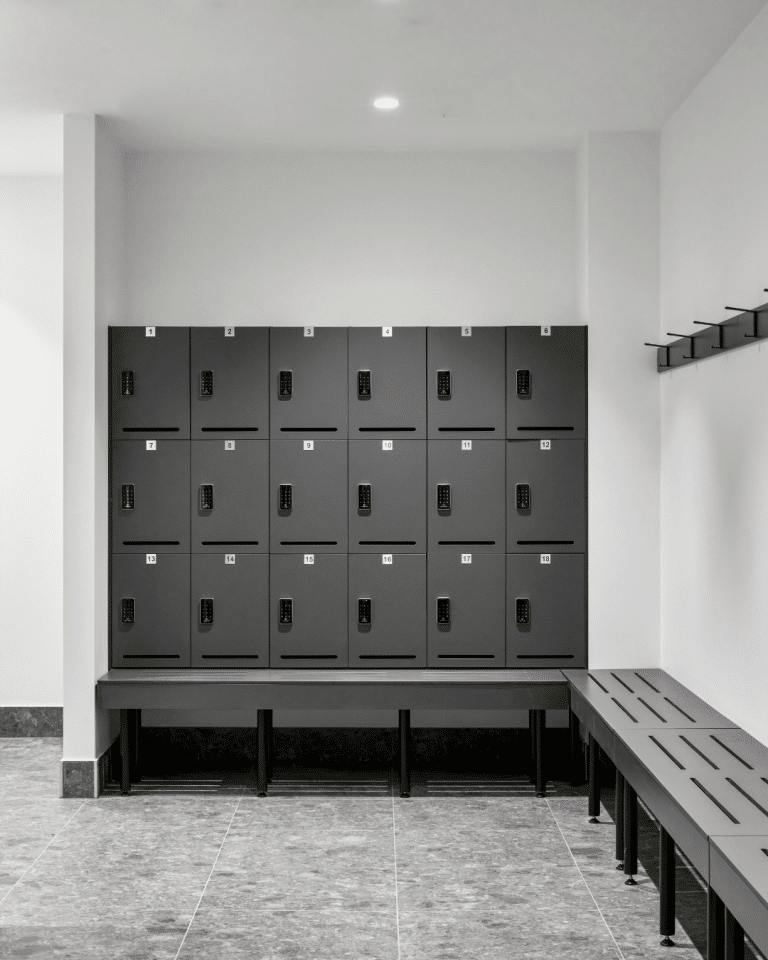
Every change room was delivered in one DuraSafe colour, 279 Charcoal, across three different product systems: Floor Mounted Overhead Braced cubicles, bench seating with coat rail, and bench-mounted lockers. Because all three come off the same material line in the same batch, the finish reads as continuous rather than coordinated, and the equity commitment in Populous’ brief becomes physically verifiable rather than aspirational.
The procurement consequence is the point for specifiers: one order, one set of shop drawings, one delivery and one point of accountability for three product types across three change room zones.
Why Buying From One Supplier Shortens Lead Times
Specifying every element from a single DuraSafe supplier changes the delivery model in three ways.
- One supplier, one programme. Partitions, vanities, lockers and bench seating are manufactured on the same line from the same batch, so there is one order, one set of shop drawings and one delivery to coordinate rather than four.
- Stocked colour, not indent. Thirty DuraSafe colours are held in stock in Australia, with a further 53 or more available on indent. Specifying from the stocked range removes the offshore sheet order from the critical path entirely.
- Cut to size, not cut on site. Panels are CNC cut, pre-drilled, routed and profiled to your drawings before they leave the factory, so site time collapses into fixing rather than fabrication.
The combined effect is a quick turnaround that a multi-supplier package cannot match. When a project is compressed, or a variation lands late, the difference between a stocked colourway cut to size and a bespoke colour ordered as sheets is usually the difference between hitting the handover date and not.
Compact Laminate Colours and Finishes
Colour range is where compact laminate has moved furthest in the last decade. Solid neutrals, timber decors, stone effects and saturated brights are all available, in matt, satin and textured finishes that hide fingerprints in high-touch areas.
The DuraSafe range holds 30 colours in stock in Australia with more than 35 further colours available on indent. The stocked palette is curated against current commercial design directions, from contemporary neutrals and biophilic naturals through to industrial and darker schemes, so a stocked selection is rarely a compromise. Full swatches sit on the DuraCube colour chart.
For projects seeking cultural narrative, the DuraSafe First Nations Range applies Blaklash-designed patterns to the same panel and the same stocked colour palette, so it integrates with a standard specification rather than sitting apart from it.
Specifying DuraSafe Compact Laminate
Most compact laminate in the Australian market is sold as sheet. A sheet supplier delivers 3600 x 1800 panels to a fabricator, and the specifier inherits the fabrication risk, the offcut waste and the lead time of whoever is doing the machining.
DuraCube supplies the compact laminate cut to size instead. Panels are cut from the 3600 x 1800 sheet to any size that fits, with standard 1.5mm aris top and bottom, and sharknose or square edge profiles available. Drilling, routed cutouts and v-grooving are done in the factory at minimal additional cost, and custom pre-drilling means base and hardware attachment is a fixing exercise on site rather than a fabrication one.
Shop drawings are provided free of charge, stock is held across New South Wales, Queensland, Victoria and South Australia, and the systems carry a 15-year warranty. For a specifier, that combination of Australian stock, in-house machining and a single point of accountability is what converts compact laminate’s material advantages into a programme advantage.
More completed examples are available in the DuraCube case study library, filterable by system and by industry.
Compact Laminate FAQs
Is compact laminate waterproof?
Yes. The panel is solid and non-porous throughout, so it can be used in showers, wet change rooms and outdoor amenity blocks without swelling, delaminating or requiring a sealed edge. Because it is impervious to water, an entire bathroom can be hosed down and the partitions wiped with a damp cloth without the material deteriorating.
Watch the demonstration: Is Compact Laminate Waterproof? (video)
How thick is compact laminate?
Commercially available thicknesses run from about 4mm to 20mm. In Australian commercial amenities 13mm is the standard for partitions, vanities, lockers and bench seating; 6mm is typical for linings and light panels; 18mm and above is used for heavy-duty benchtops.
How do you cut compact laminate?
It is cut with carbide or diamond-tipped tooling on a panel saw or CNC router, cutting from the decorative face and supporting the panel fully to avoid chipping. In practice, specifying panels cut to size at the factory removes the issue and the waste altogether.
Is compact laminate more expensive than laminated MDF?
While the upfront panel cost for compact laminate is higher, the installed cost difference is significantly smaller than it seems. Because compact laminate is self-supporting, it eliminates the need for substrates, edge taping, and additional finishing steps.
Furthermore, DuraCube back their wet-area applications with an industry-leading 15-year warranty, whereas the frequent replacement cycle of substrate-based alternatives like laminated MDF far outweighs the initial price difference over time
What is the difference between compact laminate and HPL?
HPL is a thin decorative sheet under 1mm that must be bonded to a substrate. Compact laminate is the same laminate technology built up into a thick, self-supporting panel with no substrate at all. Compact laminate is a structural element; HPL is a surface finish.
Next Steps:
- Explore the DuraSafe compact laminate cut to size service and the stocked colour range.
- Browse the DuraCube colour chart to coordinate finishes across partitions, vanities, lockers and bench seating from one supplier.
- Review the case study library for completed projects in your sector.
- Send us your plans for free shop drawings and a cut-to-size quotation.
Contact us:
Call 1300 387 228 or email sa***@**********om.au.