
Table of Contents
Ensuring Compliance Before Manufacture
At DuraCube, all our partition systems are engineered to meet the stringent requirements of the National Construction Code (NCC). While Australian Standards (AS) provide the technical framework, the NCC is the legal authority in Australia.
Critical Specifier Note: If your project requires specific AS 1428.1 (Design for Access and Mobility) certification, specifically for Ambulant cubicles, please notify our technical team before the shop drawing phase.
ESSENTIAL CHECKLIST
Cubicle Dimensions & Clearances Checklist
Best For: Architects, Specifiers, and Draftspeople verifying floorplan layouts prior to final sign-off.
Vertical Heights & Hardware Fixings Checklist
Best For: Site Managers, Installers, and Building Auditors ensuring fast certifier pass rates on site.
Layout, Circulation & Aesthetics Checklist
Best For: Interior Designers, Builders, and Project Managers optimising spatial flow and finishes.
The Regulatory Shift: NCC vs. AS 1428.1
Historically, many specifiers relied on the 2009 version of AS 1428.1. However, NCC 2022 (Amendment 2), fully actioned as of May 2023 and updated through 2025, has officially adopted the 2021 edition of AS 1428.1.
What this means for you:
- Precedence: If an old standard (AS) conflicts with the new NCC, the NCC guidelines must be followed.
- Audit Risk: Following obsolete dimensions (such as the old 1500mm hook height) can result in a compliance failure at the final building inspection.
Specify from current content, not the old standard
DuraCube's Revit BIM models are developed for fast, accurate wet-area documentation that's compliant with Australian Building Standards — so as the NCC evolves you're specifying from up-to-date content, not obsolete dimensions.
Download the Revit BIM models →Public Bathroom Layouts & Circulation
A successful public bathroom depends on “circulation space” — the room required for users to move between basins, cubicles, and exits without congestion.
- Minimum Circulation Space: Aisle widths between a row of cubicles and a wall should be 1200 mm to 1500 mm.
- Finished Surfaces: Dimensions must be measured from the finished face of the partition. Using DuraSafe 13 mm Compact Laminate instead of bulky stud walls maximises the internal floor area while maintaining structural integrity.
- Luminance Contrast: The NCC mandates a 30% luminance contrast between fixtures (like toilet seats) and the partition background.
Typical Cubicle Sizes
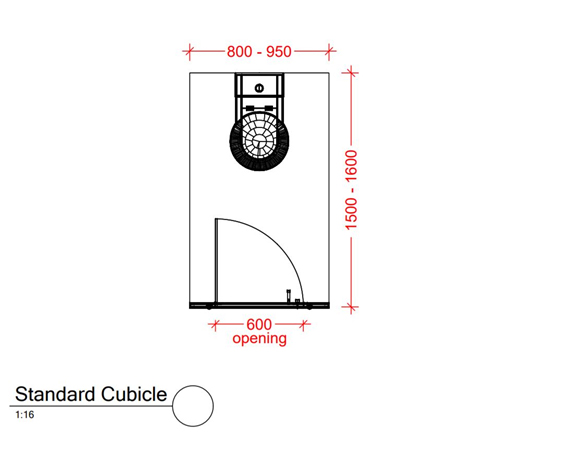
Standard toilet cubicles are recommended to be between 800–950 wide, with a typical depth of 1500–1600. See Figure 1 for details.
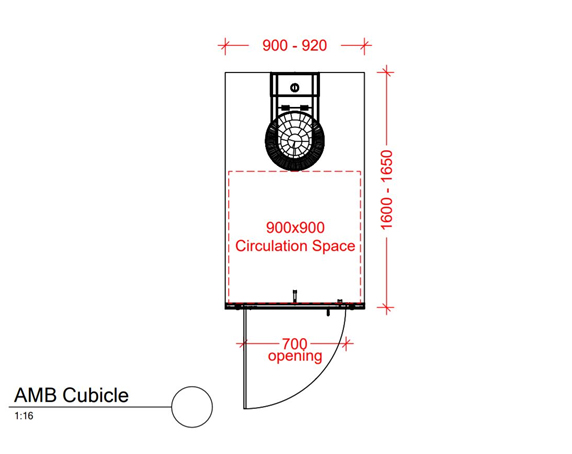
Ambulant toilet cubicles must be between 900–920 wide, with a minimum depth of toilet pan + 900 circulation space to the inside of the toilet cubicle door. This depth is typically 1600 mm. See Figure 2 for details.
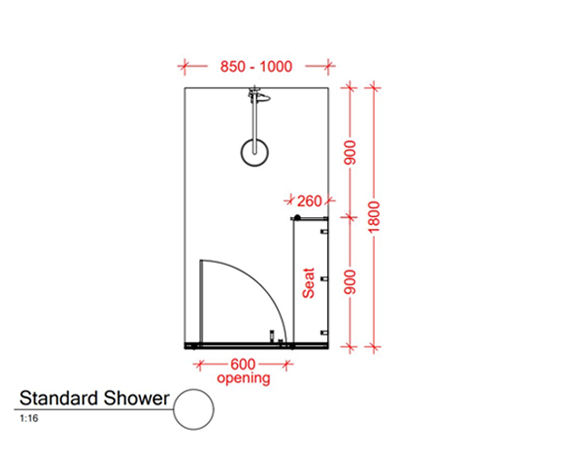
Standard Shower cubicles are recommended to be between 950–1050 wide, with a depth of 1800 mm. See Figure 3 for details.
Documenting a wet area like this in Revit?
DuraCube's partition systems, lockers and bench seating come as parametric Revit BIM families — built for compliant documentation and specification. Australia's first Revit models for wet-area systems, by an Autodesk Authorised Developer.
Standard & Minimum Toilet Cubicle Sizes
The efficiency of a floor plan is determined by the internal dimensions of the cubicle.
| Cubicle Type | Governing Code | Min. Width | Min. Depth | Clear Opening |
|---|---|---|---|---|
| Standard | NCC DTS | 800 mm | 1500 mm | 600 mm |
| Ambulant | NCC / AS 1428.1 | 900 – 920 mm | 1500 mm + | 700 mm |
| Accessible (Circulation Space) | NCC / AS 1428.1 | 1900 mm | 2300 mm | 850 mm |
The “Ambulant Update”: Mandatory Coat Hooks
The most common point of failure in recent audits is the placement of the coat hook. To align with NCC 2022/2025 reachability standards, the requirements have shifted.
- The Mandatory Hook: A coat hook is not optional in Ambulant or Accessible cubicles.
- Height Mandate: To ensure accessibility for all users, the hook must be installed between 1350 mm and 1500 mm above the finished floor level (AFFL).
Not sure your hook height passes?
Coat-hook placement is the single most common audit failure. Send us your elevation and our technical team will check reachability against NCC 2022/2025 — at no charge, before you commit to shop drawings.
Vertical Heights & Hardware
Correct vertical positioning is vital for ergonomics and legal safety requirements.
- Standard Toilet Height: General use pans should sit between 390 mm – 420 mm.
- Accessible/Ambulant Height: AS 1428.1 requires a seat height of 460 mm – 480 mm.
- Grab Rails: These must withstand a force of 1100N and positioned at a height of 800–810 mm AFFL. Our Compact Laminate provides the necessary density for these high-load fixings without the need for internal wall noggings.
- Toilet Roll Holders: Must be positioned no more than 700 mm AFFL.
Why DuraCube Systems?
In high-traffic public bathrooms, the material you choose protects the compliance of your design.
- Space Saving: Replacing 100 mm stud walls with DuraSafe 13 mm panels can gain you nearly 90 mm of extra space per cubicle.
- Green Star & Compliance: Carry a GreenRate Level A certification, ideal for Green Star rated commercial projects.
Frequently Asked Questions
What is the minimum toilet cubicle size in Australia?
For a standard cubicle, the minimum width is 800 mm. However, for a compliant ambulant stall, you must allow for 900–920 mm width.
Are coat hooks required in all toilets?
They are legally mandatory for Ambulant and Accessible cubicles under the NCC. For standard cubicles, they are optional but highly recommended for user convenience.
What is the standard toilet height in Australia?
General use: 390–420 mm. Ambulant/Accessible: 460–480 mm.
Start modelling with compliant cubicles in minutes.
Grab the parametric Revit/BIM families, or take this full guide with you as a print-ready PDF spec sheet.
Get the PDF spec sheet
Tell us where to send it — we'll email the full guide plus the matching Revit/BIM models.
Download the Revit / BIM models
Wet-area partition systems, lockers and bench seating as parametric Revit families — developed for quick, compliant documentation and specification. Drop them straight into your model.
Get the BIM models →Take this guide with you
PDF spec sheet • 1.2 MB
Tricky layout?
Our technical team can help you adhere to compliance requirements.
Send us your plan →Get the PDF spec sheet
Tell us where to send it — we'll email the full guide plus the matching Revit/BIM models.