
Every registered architect in Australia is required to complete a minimum of 20 hours of Continuing Professional Development (CPD) each year, with at least 10 of those hours classified as formal learning. Yet when renewal season arrives, many architects find themselves scrambling to locate accredited courses that are genuinely relevant to their practice. The good news is that the landscape of CPD providers has expanded significantly, and opportunities now range from free online modules to hands-on supplier presentations delivered directly to your office.
This guide maps out the major sources of accredited CPD for architects across Australia, explains what counts as formal versus informal learning, and highlights several pathways that will not cost you a cent.
Table of Contents
ToggleThe National CPD Framework: A Quick Refresher
Before exploring where to earn your points, it helps to understand what qualifies. The national CPD framework is anchored to the 2021 National Standard of Competency for Architects (NSCA), and each state or territory registration board enforces its own variation of the standard.
In most jurisdictions, the annual requirement is 20 hours of CPD, with a minimum of 10 hours being formal. Activities must typically cover at least two of the four NSCA competency units: practice management and professional conduct, project initiation and conceptual design, detailed design and construction documentation, and design delivery and construction phase services. For a deeper explanation of how these rules differ between states, our architect CPD rules guide breaks down the specifics.
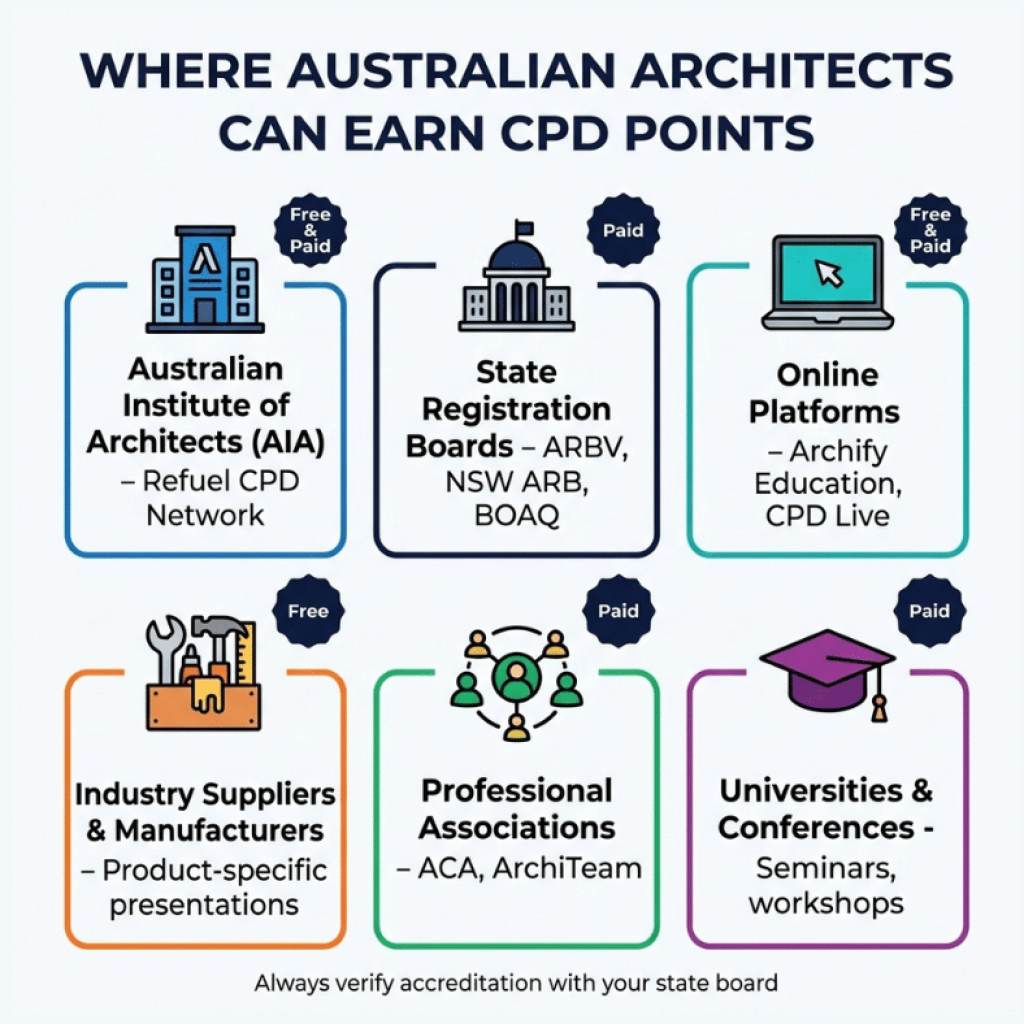
State and Territory Registration Boards
Each state registration board maintains guidance on what constitutes acceptable CPD, and several boards publish their own lists of approved providers or recommended activities. The key boards and their CPD portals include:
State/Territory | Registration Board | Key CPD Resource |
NSW | NSW Architects Registration Board (NSW ARB) | “My CPD” online portal for logging and tracking |
VIC | Architects Registration Board of Victoria (ARBV) | Annual CPD audit and compliance guidance |
QLD | Board of Architects of Queensland (BOAQ) | Approved provider listings and CPD policy |
WA | Architects Board of Western Australia | CPD guidelines and record-keeping templates |
SA | SA Architects Board | Annual reporting requirements |
TAS | Board of Architects of Tasmania | CPD compliance framework |
While these boards do not typically deliver CPD courses themselves, their websites are the authoritative source for understanding your jurisdiction’s specific rules, including any mandatory topics or reporting deadlines. If you practise in NSW, our dedicated NSW CPD requirements guide covers everything you need to know.
Free and Low-Cost Online Platforms
Several platforms have emerged specifically to address the demand for accessible, often free, CPD content for architects. These are particularly useful for practitioners in regional areas or those who prefer self-paced learning.
Archify, for instance, hosts a library of free online CPD courses covering building codes, material standards, and product-specific technical content. These courses are typically short (30 to 60 minutes), self-paced, and include a quiz or assessment that qualifies the session as formal CPD. A certificate of completion is issued automatically.
Industry Suppliers and Manufacturer-Led CPD
One of the most practical and frequently overlooked sources of CPD is the presentation programs offered by building product manufacturers. These sessions are typically free, can be delivered in-house at your practice (either in person or via webinar), and cover highly specific technical content that is directly applicable to everyday specification work.
Supplier-led CPD presentations are a legitimate and valuable pathway because they deal with real products, real compliance requirements, and real-world applications. For an architect specifying materials every day, a session on compact laminate performance standards or wet area waterproofing requirements can be more immediately useful than a generic online course.
DuraCube's CPD Presentations for Architects
As an example, DuraCube offers CPD-compliant architect training covering technical specifications for commercial toilet partitions, locker systems, bench seating, and vanity units. These sessions are designed to align with NSCA competency units, particularly detailed design and construction documentation, and are delivered by product specialists with direct project experience.
A DuraCube CPD session typically covers material selection for high-moisture environments (including compact laminate and DuraSafe specifications), compliance with Australian Standards for accessible and unisex facilities, mounting systems and their structural implications, and design considerations for durability in high-traffic commercial settings.
These presentations can be arranged at a time and format that suits your practice. DuraCube also organises catering for these sessions, making it convenient to run them during lunch hours or practice meetings. For architects looking to combine genuine technical learning with their annual CPD obligations, supplier-led sessions like these represent an efficient and highly relevant option.
Professional Associations Beyond the AIA
While the AIA is the most prominent, several other professional bodies offer CPD opportunities:
The Association of Consulting Architects (ACA) provides practice management and business-focused CPD that is particularly relevant for principals and practice directors. ArchiTeam, which represents small and sole-practitioner architectural firms, offers networking events and professional development sessions tailored to the realities of smaller practices.
State-based architecture foundations and industry groups also run periodic seminars and panel discussions. These events frequently qualify as informal CPD, though some include structured components that may count toward the formal requirement.
University and Conference-Based CPD
Attending industry conferences, symposia, and university-hosted lectures can contribute to both formal and informal CPD tallies, depending on the structure of the event. Key annual events include the AIA National Conference, the Green Building Council of Australia (GBCA) events, and state-based architecture award ceremonies that incorporate technical presentations.
For these events to count as formal CPD, they typically need to include clear learning outcomes, a presenter with relevant expertise, and some form of assessment or structured reflection. Attendance alone, without these elements, generally qualifies only as informal CPD.
University and Conference-Based CPD
Attending industry conferences, symposia, and university-hosted lectures can contribute to both formal and informal CPD tallies, depending on the structure of the event. Key annual events include the AIA National Conference, the Green Building Council of Australia (GBCA) events, and state-based architecture award ceremonies that incorporate technical presentations.
For these events to count as formal CPD, they typically need to include clear learning outcomes, a presenter with relevant expertise, and some form of assessment or structured reflection. Attendance alone, without these elements, generally qualifies only as informal CPD.
How to Track and Record Your CPD
Regardless of where you earn your points, you are personally responsible for maintaining records. Most boards require you to keep evidence for at least five years (seven years in NSW), and random compliance audits are conducted periodically.
Effective record-keeping typically includes certificates of completion for formal CPD, dates, durations, and provider details for each activity, a brief note on which NSCA competency unit each activity relates to, and any supporting documents such as session outlines or presentation slides.
Several boards now offer online portals (such as NSW ARB’s “My CPD” system) where you can log activities progressively throughout the year. This is significantly less stressful than trying to reconstruct a full year’s records at renewal time.
For a comprehensive guide to CPD record-keeping best practices, including what evidence to retain and how to prepare for a board audit, see our dedicated article.
Making CPD Work for Your Practice
A practical strategy is to split your 20 hours across a mix of delivery formats: a few structured online courses from platforms like Archify for convenience, one or two supplier-led presentations (such as a DuraCube architect training session) for hands-on technical knowledge, and a conference or seminar for broader industry engagement. This combination covers the formal and informal split, addresses multiple competency units, and keeps the learning varied enough to remain genuinely engaging.
To understand why CPD matters beyond mere compliance, and how it contributes to long-term career competitiveness, our article on CPD’s role in modern practice explores the strategic value in detail.
Next Steps
If you are looking to fulfil your CPD requirements with practical, specification-relevant content, explore DuraCube’s CPD training for architects or get in touch with our team to arrange a session for your practice.
Contact us: Call 1300 387 228 or email sa***@**********om.au.